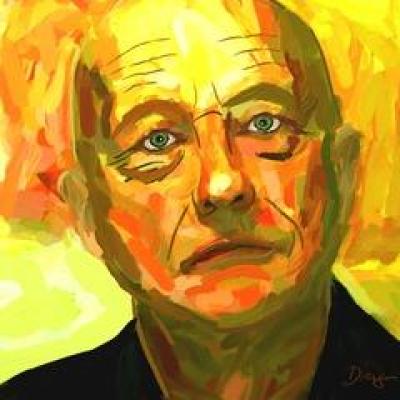
I always feel attacked when I'm asked about my painting.
Asked what role he believes art plays in society, Baselitz replied, 'The same role as a good shoe, nothing more.
When I began as an artist, I already did not like expressionism, or abstract expressionism, because abstract painting had already been done. I did not want to belong to any one group or the other, and I'm not one or the other.
Art is visceral and vulgar - it's an eruption.
No one who looks at my paintings can see whether a painting is upside down or not anymore. I've made or developed so many image models that some people have given up trying to keep track of me. But others have only one or two ways of doing things and are successful with that.
I did not always trust my teachers, because I found them too weak. I was looking for something that could take me in a new direction, for things that I could admire. And because it was so hard to find this, I became a sort of outsider. That's why I began to identify with the insane, "outsider" artists.
In the beginning, the energy involved to create came from my reaction to the work of other artists. The force behind this was aggression. The art that I saw was great, but I had to reject it, because I could not continue in the same direction. So I had to do something entirely different. It had to be so different, so extreme, that those who loved pop art, for instance, hated me. And this was my strength.
I have always had the feeling that other people are too stupid to discover interesting things. That's why I do it myself. I think of collecting as a way to show that I understand what's important better than others do.
I had always loved expressionist painting, like every European. In fact I admired it all the more because these were precisely the paintings despised by my father's generation.
I always work out of uncertainty but when a painting's finished it becomes a fixed idea, apparently a final statement. In time though, uncertainty returns.. your thought process goes on.
Women don't paint very well. It's a fact. There are, of course, exceptions. Agnes Martin or, from the past, Paula Modersohn-Becker.
I don't know who made up this sort of greatest-hits list for artists. If one artist isn't moving forward anymore, then it's assumed another one is going to take their place. With Francis Bacon's death, a whole genre of art died.
Unlike the expressionists, I have never been interested in renewing the world through the vehicle of art.
I don't paint over my paintings with black paint. I paint black paintings. It isn't because I'm sad, just as I didn't paint red paintings yesterday because I was happy. Nor will I paint yellow paintings tomorrow because I'm jealous.
A painter doesn't need any talent. In fact, it's better not to have it.
We have seen so many exhibits in recent years where the exhibition design was aesthetically beautiful. In this case, if someone wants to get something out of the exhibit, they must neglect the aesthetics and look at my pictures.
An object painted upside down is suitable for painting because it is unsuitable as an object.
All German painters have a neurosis with Germany's past: war, the postwar period most of all, East Germany. I addressed all of this in a deep depression and under great pressure. My paintings are battles, if you will.
I've painted, but I've also done graphics since as long as I can remember. So even people with little to spend could afford it. But even the graphic works are only bought by those who buy the big, expensive paintings. I think that's troublesome.
The reality is the picture, it is most certainly not in the picture.
I am not a representative of anything. When art historians or critics or the public put somebody in a drawer like this, it has a tranquilizing, paralyzing effect. Artists are individuals. They have ideas, and the conventions for one's self as an individual are not for a group. There are always those who follow the group, but they belong in the margins. I refuse to be placed within, or added to, one particular school.
There's a market for art, and things are indeed going swimmingly, especially for German artists. But everything takes place in America and in London, where there are quite a few wealthy, engaged people. What motivates them to buy art is a different question, but they do.
You dig in and you find something.
I became an artist because of the possibility it gave me to develop in another way, because I didn't want to follow the same lines the others around me did. I was educated in the former German Democratic Republic, which meant that an individual figure had to be... like a soldier in the army.
I dont want to create a monster; I want to make something which is new, exceptional, something that only I do...something that references tradition, but is still new.
I love my old paintings as postulates as fresh starting points but I have to destroy them. I have to make a new manifesto.
When Michael Werner saw a painting of mine, such as Die grosse Nacht im Eimer, which back then nobody wanted and everybody thought was ridiculous, he realized that this was the right provocation, that it represented the feeling of the times in the right way.
I hang my work upside down to emphasize surface.
Nowhere in my collection do I, say, have a Auguste Renoir painting. Because everybody knows that this is a good painter without me having to demonstrate it.
What counts most is finding new ways to get the world down in paint on my own terms.
I have always been aware of different movements and directions in art. But, in general, I'm always bored by any kind of generalization when it comes to artists. I think that there are just single individuals, who are valuable, and they work outside of any group.
I paint German artists whom I admire. I paint their pictures, their work as painters, and their portraits too. But oddly enough, each of these portraits ends up as a picture of a woman with blonde hair. I myself have never been able to work out why this happens.
Alfred Schnittke was an important contemporary composer, and he lived in Germany, but no one here has heard of him. Everyone has heard of Mozart, and many believe that he can still be found in that little house in Salzburg, which is why people stand there in line. I think that our music and our art belong to our era. If the public doesn't show up, it must be stupid.
What I could never escape was Germany, and being German.
Spending money on art has always been frowned upon in this country - even earlier, when my and others' paintings cost almost nothing. Something is always more important. The people in charge are always peddling reasons that others seem to accept. Those who don't drink and aren't crazy, or who don't attract attention with how they behave in public, aren't noticed in art.
My Paintings are Battles.
As a human being, I am a citizen, but as an artist, I am asocial.
I do not have a philosophy about retrospectives. Of course, I cannot change what I have done. What I am doing today, this I can change, in view of whatever I have done before. My retrospectives are like a series of ghosts.
You cannot deny your origins: I love Kirchner more than Matisse, although Matisse was a greater artist. That isn't to do with nationality. It's a stronger feeling.
As an artist, I have been a risk-taker. And I've done a lot of different things. I don't make it easy for people. Identification is difficult. One doesn't recognize my art right away.
I would say for everyday I build buildings or houses like a bricklayer with canvas and paint.
That was in 1957. And there I found out that Germany is a kind of province. I didn't know anything about expressionism, about the Bauhaus and Dada and surrealism. I was uneducated, so to speak - and everybody else was more or less uneducated, too.
Most of arts what comes from the States to Europe has something to do with entertainment. I can't imagine artists in the United States having the same kind of isolated position that we have here in Europe. I have a feeling one lives more publically in the States.
I begin with an idea, but as I work, the picture takes over. Then there is the struggle between the idea I preconceived... and the picture that fights for its own life.
Museums collect what's important in their respective countries. In Berlin's National Gallery, however, this isn't the case. They're interested neither in me nor the other usual suspects. It's simply a German reality.
The artist is not responsible to any one. His social role is asocial... his only responsibility consists in an attitude to the work he does.
I think the defect actually lies with male artists. Male artists often border on idiocy, while it's important for a woman not to be that way, if possible. Women are outstanding in science, just as good as men.
I started collecting my artist friends, artists like myself who nobody had yet noticed. In everything, all I am collecting, so to speak, are my friends - artist friends.
Despite all the taxes people pay, there supposedly isn't any money in this country for art. Of course, this makes an artist ask himself: "Well, then, what are you doing with the 100 million I pay each year? What happened to that money?" And he doesn't get an answer.
There is no communication with any public whatsoever. The artist can ask no question, and he makes no statement; he offers no information, and his work cannot be used. It is the end product which counts.
Talent seduces us into interpretation. My sister could draw wonderfully, but she would never have hit upon the idea of becoming a painter. I never had that extreme talent.
A citizen sticks to conventions, does whatever is social. Artists, of course, must reject all conventions. I see no differently in reconciling the best of both of these worlds.
I was always on the outside. It was the worst when I still wanted to be a professor, having to deal with colleagues and students, and having to listen to all that academic nonsense. It's really just a haze that keeps them busy. But all of that is fortunately over now, once and for all.
I don't see art as entertainment.
I remember that Michael Werner told me about a famous collector, and Michael set up an appointment for us to meet. This man looked around the room and at my pictures. Then he said, "Young man, why are you doing these horrible things? Look out the window. There are nice girls out there. It's springtime. Look at how beautiful the world can be. You'll ruin your health by smoking so much and doing such tortured things."
I don't like things that can be reproduced. Wood isn't important in itself but rather in the fact that objects made in it are unique, simple, unpretentious.
The idea of changing or improving the world is alien to me and seems ludicrous. Society functions, and always has, without the artist. No artist has ever changed anything for better or worse.
In a place like the Guggenheim, I would like to be a representative of arte povera. This would be my ideal.
In Germany, we often hear the absurd complaint that museums don't have the money to buy paintings. Of course, I'm not talking about me and my paintings. There are, after all, more popular painters in this country.