And last of all comes death.
The sea drinks the air and the sun the sea.
War spares not the brave, but the cowardly.
For when we quaff the gen'rous bowl, Then sleep the sorrows of our soul. Let us drink the juice divine, The gift of Bacchus, god of wine. When I take wine, my cares go to rest.
Today is ours; what do we fear? Today is ours: we have it here. Let's treat it kindly, that it may Wish at least with us to stay.
Thus, while I quaff the genial wine, I live mid transports quite divine.
Cursed be he above all others Who's enslaved by love of money. Money takes the place of brothers, Money takes the place of parents, Money brings us war and slaughter.
My Passion uncontrolled shall rove, Doubly debauched with Wine and Love.
Ah, cruel 'tis to love, And cruel not to love, But cruelest of all To love and love in vain.
He who has a mind to fight, let him fight, for now is the time.
Let others seek renown in arms; For me wine's wars have greater charms: Then fill the bowl, boy; fill it high: 'Tis better drunk, than dead to lie.
I both love and do not love; and am mad and not mad.
How the waves of the sea kiss the shore!
To-day belongs to me, To-morrow who can tell.
Life is like a chariot-wheel that ever rolls along.
Author details
Anacreon: Biography and Life Work
Anacreon was a notable Lyric poet.
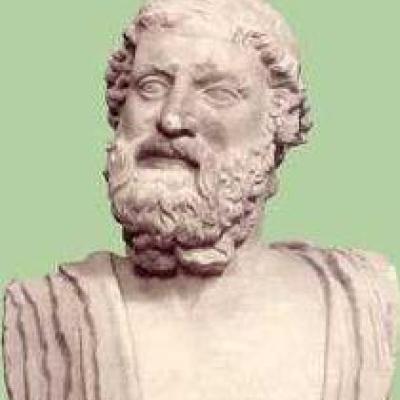
Anacreon ( c. 573 – c. 495 BC) was an Ancient Greek lyric poet , notable for his drinking songs and erotic poems . Later Greeks included him in the canonical list of Nine Lyric Poets . Anacreon wrote all of his poetry in the ancient Ionic dialect . Like all early lyric poetry , it was composed to be sung or recited to the accompaniment of music, usually the lyre . Anacreon's poetry touched on universal themes of love, infatuation, disappointment, revelry, parties, festivals, and the observations of everyday people and life.
Legacy and Personal Influence
Historically, their work is best remembered for Drinking songs, erotic poems, being one of the.
Major Contributions
- Drinking songs, erotic poems, being one of the
- Nine Lyric Poets
Philosophical Views and Reflections
Anacreon had a reputation as a composer of hymns, as well as of those bacchanalian and amatory lyrics which are commonly associated with his name. Two short hymns to Artemis and Dionysus , consisting of eight and eleven lines respectively, stand first amongst his few undisputed remains, as printed by recent editors. But hymns, especially when addressed to such deities as Aphrodite , Eros and Dionysus , are not so very unlike what we call "Anacreontic" poetry as to make the contrast of style as great as the word might seem to imply. The tone of Anacreon's lyric effusions has probably led to an unjust estimate, by both ancients and moderns, of the poet's personal character. The "triple worship" of the Muses , Wine and Love, ascribed to him as his religion in an old Greek epigram, may have been as purely professional in the two last cases as in the first, and his private character on such points was probably neither much better nor worse than that of his contemporaries. Athenaeus remarks acutely that he seems at least to have been sober when he wrote. His character was an issue, because, according to Pausanias , his statue on the Acropolis of Athens depicts him as drunk. He himself strongly repudiates, as Horace does, the brutal characteristics of intoxication as fit only for barbarians and Scythians .
In the visual arts, Anacreon was largely shown in a biographical or literary context: Raphael painted him in the company of Sappho in Parnassus , while a caricature by Honoré Daumier illustrates the ancient story that he choked to death on a grape seed. The ancient stereotype of Anacreon as the elderly, drunken poet of love was illustrated by Nicolas Poussin and Jean-Léon Gérôme .