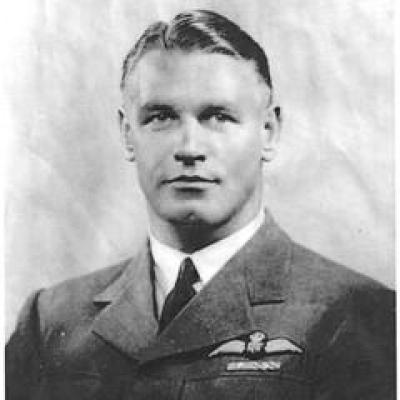
Always keep a sharp lookout. "Keep your finger out"!
Go in quickly - Punch Hard - Get out!
Make your decisions promptly. It is better to act quickly even though your tactics are not the best.
When diving to attack always leave a proportion of your formation above to act as top guard.
Never fly straight and level for more than 30 seconds in the combat area.
Always turn and face the attack.
Fire short bursts of 1 to 2 seconds and only when your sights are definitely 'ON.'
Height gives you the initiative.
INITIATIVE, AGGRESSION, AIR DISCIPLINE, and TEAM WORK are words that MEAN something in Air Fighting.
Whilst shooting think of nothing else; brace the whole of the body; have both hands on the stick; concentrate on your ring sight.
Author details
Sailor Malan: Biography and Life Work
Sailor Malan was a notable South African fighter pilot and flying ace in the Royal Air Force. The story of Sailor Malan began on 3 October 1910 in Wellington, Cape Province. The legacy of Sailor Malan continues today, following their passing on 17 September 1963 in Kimberley, Cape Province.
Adolph Gysbert Malan , DSO & Bar , DFC & Bar (3 October 1910 – 17 September 1963), better known as Sailor Malan , was a South African fighter pilot and flying ace in the Royal Air Force (RAF) who led No. 74 Squadron RAF during the Battle of Britain . He finished his fighter career in 1941 with twenty-seven destroyed, seven shared destroyed and two unconfirmed, three probables and sixteen damaged. At the time he was the RAF's leading ace, and one of the highest-scoring pilots to have served wholly with RAF Fighter Command during the Second World War.
Philosophical Views and Reflections
On 29 December 1941 Malan was added to the select list of airmen who had sat for one of Cuthbert Orde 's iconic RAF charcoal portraits. He had the rarer honour of also being the subject of a full colour painting by Orde.
Malan died at the age of 52 on 17 September 1963 from Parkinson's disease , at the time a rare and little understood medical condition. A considerable sum of money was raised in his name to further study the disease. His funeral service was at St Cyprian's Cathedral, Kimberley , and his body was buried at West End Cemetery in Kimberley, Cape Province . Due to his prominent role in opposition to apartheid, the South African government sought to marginalise his death in order to erase any legacy of the Torch Commando . Malan was not permitted a military funeral and all South African military personnel who attended his funeral were instructed not to wear their uniforms. The South African Air Force was instructed not to give any tribute to his death.