
Adolf eichmann

From my childhood, obedience was something I could not get out of my system. When I entered the armed service at the age of twenty-seven, I found being obedient not a bit more difficult than it had been during my life to that point. It was unthinkable that I would not follow orders.

Adolf Hitler may have been wrong all down the line, but one thing is beyond dispute: the man was able to work his way up from lance corporal in the German Army to Führer of a people of almost 80 million. His success alone proved that I should subordinate myself to this man.

To sum it all up, I must say that I regret nothing.

Your time will come to follow me Jew

I was one of the many horses pulling the wagon and couldn't escape left or right because of the will of the driver.

I will leap into my grave laughing because the feeling that I have five million human beings on my conscience is for me a source of extraordinary satisfaction.

I am certain, however, that those responsible for the murder of millions of Germans will never be brought to justice.

Now that I look back, I realize that a life predicated on being obedient is a very comfortable life indeed. Living in such a way reduces to a minimum one's own need to think.

My political sentiments inclined toward the left and emphasized the socialist aspects every bit as much as nationalist ones.

I never did anything, great or small, without obtaining in advance express instructions from Adolf Hitler or any of my superiors.

Long live Germany. Long live Austria. Long live Argentina. These are the countries with which I have been most closely associated and I shall not forget them. I had to obey the rules of war and my flag. I am ready.

Repentance is for little children.
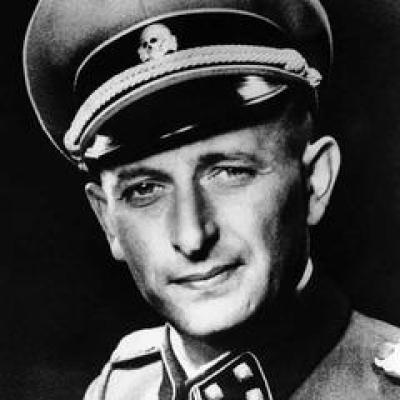
Author details

Adolf Eichmann: Biography and Life Work

Adolf Eichmann was a notable German-Austrian official of the Nazi Party. The story of Adolf Eichmann began on 19 March 1906 in Solingen, Germany. The legacy of Adolf Eichmann continues today, following their passing on 1 June 1962 in Ayalon Prison, Ramla, Israel.

Otto Adolf Eichmann was a German-Austrian official of the Nazi Party , an officer of the Schutzstaffel (SS), a convicted war criminal , and one of the major organisers of the Holocaust . He participated in the January 1942 Wannsee Conference , at which the implementation of the genocidal Final Solution to the Jewish Question was planned. Following this, he was tasked by SS- Obergruppenführer Reinhard Heydrich with facilitating and managing the logistics involved in the mass deportation of millions of Jews to Nazi ghettos and Nazi extermination camps across German-occupied Europe . He was captured and detained by the Allies in 1945, but escaped and eventually settled in Argentina. In May 1960, he was tracked down and apprehended by Israel's Mossad intelligence agency, and put on trial before the Supreme Court of Israel . The highly publicised Eichmann trial resulted in his conviction in Jerusalem , following which he was executed by hanging in 1962.

Legacy and Personal Influence

Personally, Adolf Eichmann was married to Veronika Liebl.

Philosophical Views and Reflections

Eichmann was extensively interviewed for four months beginning in late 1956 by Nazi expatriate journalist Willem Sassen with the intention of producing a biography. Eichmann produced tapes, transcripts, and handwritten notes. The surviving audio recordings became public in 2022. Eichmann confessed that he knew that millions of Jews and others were being killed: "I didn't care about the Jews deported to Auschwitz, whether they lived or died. It was the Führer's order: Jews who were fit to work would work and those who weren't would be sent to the Final Solution." Sassen asked him: "When you say Final Solution, do you mean they should be eradicated? ", to which Eichmann replied: "Yes."

In her 2011 book Eichmann Before Jerusalem , based largely on the Sassen interviews and Eichmann's notes made while in exile, Bettina Stangneth argues that Eichmann was an ideologically motivated antisemite and lifelong committed Nazi who intentionally built a persona as a faceless bureaucrat for presentation at the trial. Historians such as Christopher Browning , Deborah Lipstadt , Yaacov Lozowick , and David Cesarani reached a similar conclusion: that Eichmann was not the unthinking bureaucratic functionary that Arendt believed him to be. Historian Barbara W. Tuchman wrote of Eichmann, "The evidence shows him pursuing his job with initiative and enthusiasm that often outdistanced his orders. Such was his zeal that he learned Hebrew and Yiddish the better to deal with the victims." Concerning the famous characterisation of his banality, Tuchman observed, "Eichmann was an extraordinary, not an ordinary man, whose record is hardly one of the 'banality' of evil. For the author of that ineffable phrase—as applied to the murder of six million—to have been so taken in by Eichmann's version of himself as just a routine civil servant obeying orders is one of the puzzles of modern journalism."

EQ
Empery Quotes
Inspire · Reflect · Repeat